

Stemless Champagne Flutes vs Traditional Flutes: Event Guide
Stemless champagne flutes and traditional flutes can serve the same sparkling drink, but they solve different event problems. The right choice depends less on etiquette than on how guests will move, where staff will stage drinks, and how quickly used cups must be collected.

Stemless vs traditional champagne flutes at a glance
| Decision factor | Stemless flute | Traditional flute |
|---|---|---|
| Best fit | Outdoor receptions, cocktail hours, self-service bars, crowded tables | Formal toasts, plated dinners, staged photo moments |
| Stability | Lower center of gravity and a wider contact point | Raised bowl with a separate base; needs more careful placement |
| Guest handling | Familiar tumbler-style grip | Stem offers a dedicated holding point |
| Tray and shelf space | Compact height can simplify staging | Taller profile creates a classic presentation |
| Capacity planning | Check the stated ounce capacity; do not fill to the rim | Smaller sizes can support controlled toast pours |
Practical judgment: stemless flutes are usually the more forgiving format when guests circulate between standing tables, patios, and dance floors. Service judgment: a smaller traditional flute is often easier to standardize for a single coordinated toast. Design judgment: the silhouette should follow the event flow—not the other way around.
When stemless champagne flutes work best
A stemless flute is useful when the drink station must remain compact or when guests will set cups on mixed surfaces. Its shorter overall height can make staging and bussing more straightforward. It also looks natural beside other plastic champagne flutes and clear event drinkware.
Outdoor and high-movement events
For garden receptions, patios, networking events, or standing cocktail hours, prioritize a stable base and an uncluttered route between service points. “Stable” does not mean spill-proof: every cup still needs a level surface and sensible fill line.
Bars serving more than sparkling drinks
A 9 oz stemless format can cover toast pours and selected cocktails, while larger 12 oz or 16 oz stemless wine glasses can support water, spritzes, or nonalcoholic drinks. Match each beverage to the product’s stated intended use and capacity.
When traditional flutes are the better choice
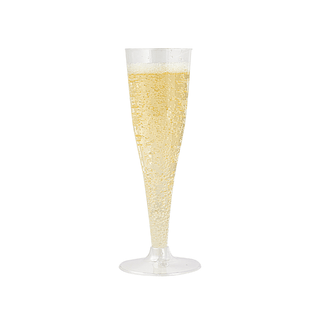
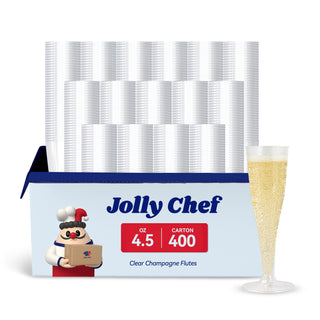
Traditional stemmed flutes create immediate visual separation from water glasses and everyday cups. That makes them useful for a defined toast, welcome pour, or formal place setting. A 4.5 oz clear stemmed flute is particularly suited to a measured toast rather than a full-service beverage.
If quantity is your main question, use our separate champagne flute quantity guide. This article focuses on choosing the form; the quantity guide handles guest count and backup planning.
A three-step selection workflow

Mark the bar, toast area, guest routes, outdoor zones, and collection points. Choose the shorter format where traffic is dense.
Decide whether the cup is for one toast, repeated sparkling pours, or multiple beverages. Select capacity from that use—not from appearance alone.
Set one loaded tray and one table place before ordering the full quantity. Check spacing, reach, pickup, and the route to collection bins.
Product options for different event flows
These options were selected from Jolly Chef’s active overseas-warehouse assortment at publication time. Availability can change, so confirm the live product page before ordering.
9 oz stemless flutes
A balanced option for sparkling drinks, cocktail hours, and mixed indoor-outdoor service.
12/16 oz stemless glasses
Useful when the same visual family needs additional capacity for wine, spritzes, water, or zero-proof drinks.
4.5 oz traditional flutes
A compact stemmed format for coordinated toast service and formal presentation.

Planning boundaries that matter
Cup capacity is not a recommended alcohol serving size. In the United States, the National Institute on Alcohol Abuse and Alcoholism explains standard-drink equivalents and notes that beverage alcohol content varies; see the NIAAA standard drink guidance. Follow venue rules, local laws, and responsible-service practices. Product dimensions, pack counts, and inventory should always be confirmed on the current product page.
For large orders or recurring venue needs, Jolly Chef’s business solutions page provides a path to discuss operational requirements.
Frequently asked questions
Are stemless champagne flutes more stable?
Their shorter profile and broad contact area can make them easier to place on busy tables, but stability still depends on the surface, fill level, and guest handling.
Do stemless flutes look formal enough for weddings?
Yes. Clear stemless flutes can suit modern, minimalist, outdoor, and cocktail-style weddings. Traditional flutes remain the clearer choice when a classic silhouette is central to the tablescape.
What size works for a wedding toast?
A smaller flute can suit a single controlled toast; a 9 oz stemless flute provides more flexibility. Plan the actual pour separately from the cup’s maximum capacity.
Can one event use both styles?
Yes. Use stemless flutes for circulation areas and traditional flutes for the scheduled toast. Keep collection bins separated if your disposal or recycling workflow requires it.
Should I choose PET or PS plastic?
Choose only products intended for your planned food-contact use, then compare clarity, construction, and the manufacturer’s care instructions. Do not infer heat resistance or reuse suitability from appearance.
How should I estimate quantities?
Count guests, planned pours, service zones, and a practical contingency. For a dedicated method, follow the linked quantity guide rather than assuming one cup per guest fits every event.