







Holiday Catering Checklist: A 6-Week Prep Timeline
Holiday catering compresses several risks into one service window: changing guest counts, seasonal menus, limited receiving time, unfamiliar venues, and short setup periods. This six-week holiday catering planning timeline helps restaurants, caterers, and event teams convert a broad event brief into verified quantities, labeled zones, and a load-out that can be checked without guesswork.

Holiday Catering Checklist by Week
| Timing | Primary decision | Required evidence | Release gate |
|---|---|---|---|
| 6 weeks out | Define service format, guest profile, venue limits, and decision owner | Signed brief, venue access notes, dietary process, weather backup | One approved operating plan |
| 5 weeks out | Build the menu and service-zone map together | Menu draft, holding method, station footprints, waste route | Every menu item has a service vessel and station |
| 4 weeks out | Confirm suppliers, products, case packs, and replacements | Current product pages, inventory, lead times, receiving window | Approved purchase list with alternates |
| 3 weeks out | Convert headcount into counted station kits | Guest assumption, staff meals, service model, pack quantities | Quantities reconcile to cases and station bins |
| 2 weeks out | Run a complete portion, holding, carrying, and cleanup test | Timed rehearsal, breakage notes, temperature-control roles | Failures have owners and retest dates |
| 1 week to load-out | Receive, count, label, stage, and verify | Receiving log, zone labels, load map, final checklist | Named checker signs off before departure |
A catering timeline is reliable only when every deadline ends with a verifiable deliverable.
Six Weeks Out: Freeze the Operating Assumptions
Start with facts that affect every later quantity: expected attendance, seated or buffet service, number of courses, beverage service, venue access, setup and breakdown windows, indoor or outdoor conditions, and the process for allergies or dietary needs. Assign one person to approve changes. A guest-count change is not a note; it is a trigger to rerun food, tableware, staffing, and transport quantities.
Map the event as arrival, drinks, food, dining, waste, and departure zones. The existing fall catering buffet setup guide explains one-way guest flow and separate restocking for buffet-format events. Use it as the layout layer; keep this article as the timeline and verification layer.
Four to Five Weeks Out: Match the Menu to Service Hardware
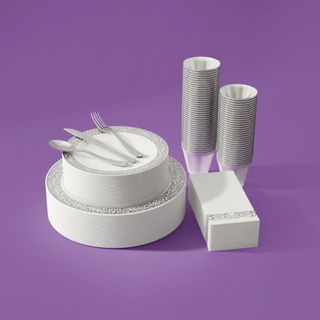
Review each menu item against plate size, cutlery need, beverage format, holding method, and cleanup route. A coordinated place setting can simplify a formal buffet or seated holiday meal, while separate components may be more efficient for stations that serve only one course.
Use the disposable dinnerware sets collection as a starting point for coordinated settings and the flatware collection when utensils must be counted independently. Businesses planning repeat or high-volume orders can review Jolly Chef business solutions.
Choose tableware from the menu and service flow backward; visual style comes after fit, handling, and quantity.
Three Weeks Out: Build Counted Station Kits
Do not apply a universal buffer without evidence. Begin with the confirmed service model: whether each guest receives one place setting, whether plates are changed between courses, whether beverage vessels are reused, and whether staff or vendor meals use the same items. Add documented replacements based on the team's own receiving defects, breakage, guest-count volatility, and case-pack constraints.
| Item | Base quantity | Add separately | Pack check |
|---|---|---|---|
| Dinner plates | Guests × planned plate changes | Staff meals and documented replacements | Round up to purchasable pack or case |
| Pre-rolled cutlery | Guests receiving that utensil set | Station backups and staff meals | Count into labeled service bins |
| Toast flutes | Confirmed toast participants | Alcohol-free service and replacements | Verify rack and transport capacity |
| Napkins | Per-place-setting and station needs | Cocktail, dessert, and cleanup uses | Separate guest-facing and reserve stock |
Two Weeks Out: Run the Complete Service Test
Plate the full menu using the exact serving utensils and vessels.
Use the expected time and approved temperature-control process.
Walk the real tray, rack, or bin route and note instability.
Replenish one station without crossing the guest path.
Test waste separation and table-reset timing.
Assign every failure an owner, correction, and retest date.

The first full rehearsal should happen early enough to change the order, not merely early enough to document a problem.
Holiday Service Products Verified for This Guide
The following products were Active and had available variants with SKUs containing hwc immediately before publication. Inventory can change, so verify the exact variant again before purchasing.

Useful when plates, napkins, cups, and utensils need a coordinated place-setting plan.

Supports counted place-setting bins and faster station deployment.

Suitable for a planned toast station with separate alcohol-free service.
Food-Safety and Planning Boundaries
The FDA's Safe Food Handling guidance emphasizes cleaning, separation, proper cooking, and prompt chilling. Retail food operations must also follow the applicable state and local rules; the FDA summarizes hot- and cold-holding considerations in its retail food handling guidance.
FAQ
When should holiday catering planning start?
Start about six weeks before service when suppliers, staffing, venue access, or a custom menu are involved. Smaller repeat events may need less lead time, but the plan still needs menu, quantity, service-test, and final-count gates.
What belongs on a holiday catering checklist?
Include the event brief, menu, dietary process, supplier status, quantities, equipment, staffing, venue access, temperature-control roles, zone map, load order, cleanup route, and named final checker.
How do caterers calculate disposable tableware?
Multiply confirmed participants by the number of planned vessel changes, then add staff meals and a documented contingency. Reconcile the result to current pack and case quantities.
When should a catering service test happen?
Run the first complete test about two weeks before service. That leaves time to correct a product, quantity, holding, transport, or layout problem and retest it.
How should holiday catering supplies be packed?
Pack by service zone and load in reverse use order. Label each bin with destination, item, count, owner, and reserve status so the setup team can verify it without opening every container.
How can a catering team prevent last-minute shortages?
Freeze change deadlines, count received goods against purchase records, isolate reserve stock, and rerun quantities after every approved guest or menu change. Avoid relying on an unverified universal buffer.


