




Best Microwave-Safe Paper Plates for Foodservice
Last updated July 24th, 2026
An objective framework for choosing microwave-safe disposable plates by material, menu, format, pack size, and operating workflow.
Five objective criteria for product selection
- Documented microwave suitability: rely on the current product label or specification and stay within the stated instructions.
- Menu fit: consider food weight, moisture, oil, sauces, cutting, and the need to keep components separate.
- Operational fit: confirm the plate fits the microwave, storage area, tray, service counter, and waste-handling process.
- Pack and replenishment fit: compare usable quantity, variant-level availability, storage capacity, and reorder cadence.
- Presentation fit: select color and format appropriate for the service setting without treating appearance as a substitute for performance documentation.
This framework compares product types and use cases—not companies. It avoids unsupported claims and gives purchasing teams a repeatable way to document why a product was chosen.
Plate formats compared by use case
| Format | Often a good fit for | Selection focus | Questions to ask |
|---|---|---|---|
| 6-inch round | Desserts, snacks, samples, bread service | Compact portions and efficient storage | Will the food remain within the rim? |
| 9-inch round | Standard lunches and medium entrées | Versatility across common menus | Is the structure appropriate for the meal weight? |
| 10-inch round | Large entrées, buffets, catered meals | Serving area and load distribution | Does it fit the equipment and trays? |
| 3-compartment | Combination meals, schools, offices, catering | Separation and portion organization | Are the compartment volumes right for the menu? |
| White molded fiber | Neutral presentation across many settings | Size, pack, and documented use | Which variant supports the workflow? |
| Natural molded fiber | Programs that prefer a visible natural-fiber look | Presentation and supply consistency | Does the appearance match the service concept? |
Current product options by service need
The following products are not presented as a winner-versus-loser ranking. Each is a current Jolly Chef Online Store option with total inventory above one and a product description that supports short microwave reheating. Choose the format that best matches the documented requirement.

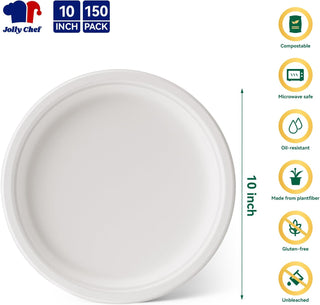
White Round Sugarcane Plates
Best fit: teams needing several round sizes and box/carton choices under one product family.
View product details
Natural Brown Sugarcane Plates
Best fit: round-plate programs seeking a natural brown molded-fiber presentation in several sizes.
View product details
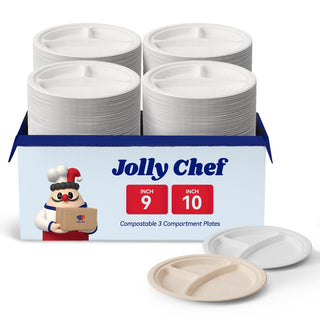
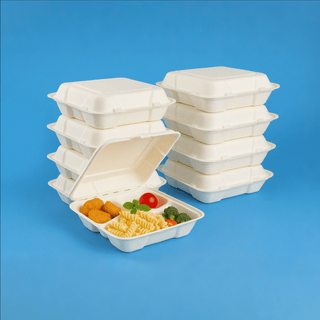
White 3-Compartment Sugarcane Plates
Best fit: combination meals where separation of mains and sides supports service consistency.
View product details
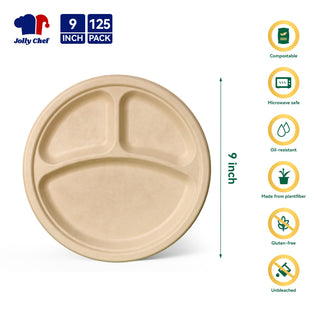
Natural Brown 3-Compartment Sugarcane Plates
Best fit: combination-meal programs seeking a natural brown molded-fiber presentation and separate food sections.
View product detailsObjective-use note: “Best fit” refers only to the stated use case. It does not imply that one material, supplier, or brand is universally superior. Review current product details and packaging before operational use.
A practical five-step decision process
- Write the use case. Name the food, portion, microwave, service setting, and expected daily volume.
- Remove non-matching formats. Exclude options that lack clear microwave instructions or do not fit the size and workflow requirements.
- Compare the remaining options. Review pack size, exact variant inventory, storage footprint, presentation, and ordering cadence.
- Run a controlled workflow test. Use the real menu and equipment while following the product instructions.
- Record the approved choice. Keep the SKU, use instruction, receiving checklist, and review date available to purchasing and service staff.
Frequently asked questions
Is bagasse always microwave-safe?
No material should be treated as automatically microwave-safe. Many molded sugarcane-fiber products are designed for short reheating, but the specific product label and instructions remain decisive.
Should we choose a round or compartment plate?
Choose round plates for flexible plating and compartment plates when separation or portion organization is operationally important. The menu and service flow should determine the format.
How can we compare suppliers fairly?
Use the same written criteria for every option: documented use, size, structure, pack count, availability, storage, service test, and total purchasing requirements. Avoid conclusions that are not supported by comparable evidence.